Skip to content

AI answers. Held to the evidence.

AI is shaping your market and influencing brand demand. Know which claims stand up to the evidence, and act on the ones that don’t.

Proof, from our published research

What AI gets wrong. What it leaves out. Why it matters.

Our research has documented outdated regulatory claims, false premises behind medicine recommendations and missing evidence in treatment comparisons. Here are three findings.

01 · Outdated evidenceKeytruda · United States

The regulator changed the indication. Some AI answers didn’t.

In our pre-specified study of 936 AI answers across two medicines, four of eight models repeatedly stated an outdated Keytruda indication above the study’s threshold. Then, on Google, the same question produced opposite answers from two AI search features, seventy minutes apart.

Google AI Mode

Current indication

Reflected the FDA’s updated eligibility restriction.

Google AI Overview

Outdated indication

Repeated the superseded rule, citing an authentic older FDA source.

On a second question, both features reached the correct conclusion, but AI Mode supported it with an outdated explanation. These are documented observations, not an estimate of Google Search’s overall error rate.
02 · False claims

The medicine was approved. AI used a false premise to reject it.

20 of 52

In a UAE buyer-choice study, 20 answers described Wegovy as unapproved or unavailable. In 19, that false status was the stated reason for recommending Mounjaro.

03 · Omissions

A comparison can be incomplete without being entirely wrong.

About 1 in 5

Across 144 answers comparing Zepbound and Wegovy, about one in five covered a category of US prescribing information for one medicine while leaving it out for the other.

The asymmetry concerns evidence coverage, not proof of deliberate favouritism.

Visibility tells you what AI said. Evidence tells you what deserves attention.

How it works

From AI answers to accountable action.

  1. 01 Observe

    What is AI saying?

    Your questions, put to ChatGPT, Claude, Gemini and Perplexity through their official APIs on a schedule, and Observed Intelligence: Google’s AI answers as people see them in their markets. Every answer is kept with the sources it cited.

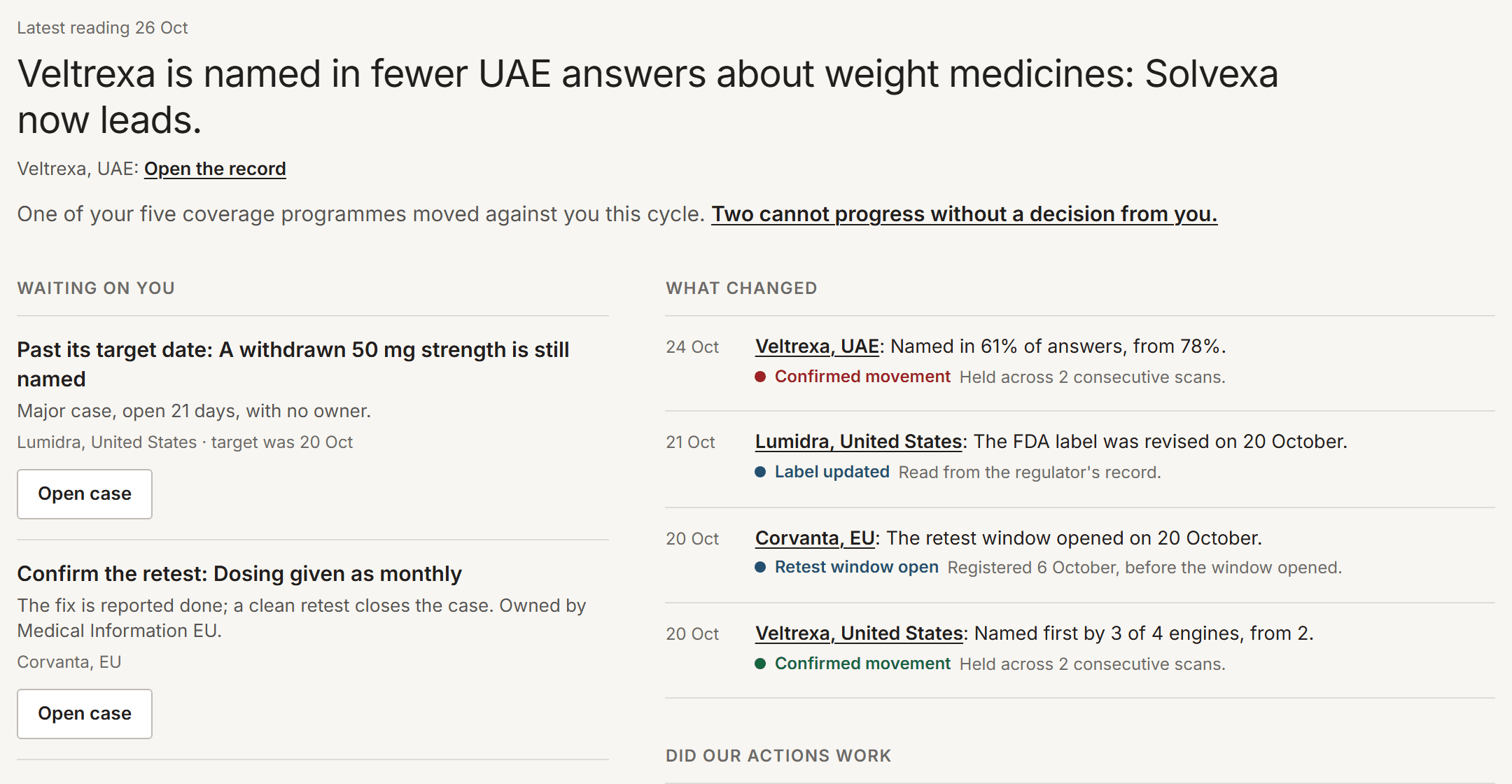
    The Brief in the AlphaCitation account: the cycle's headline finding, what is waiting on the team, and what changed.
  2. 02 Verify

    Does the claim hold?

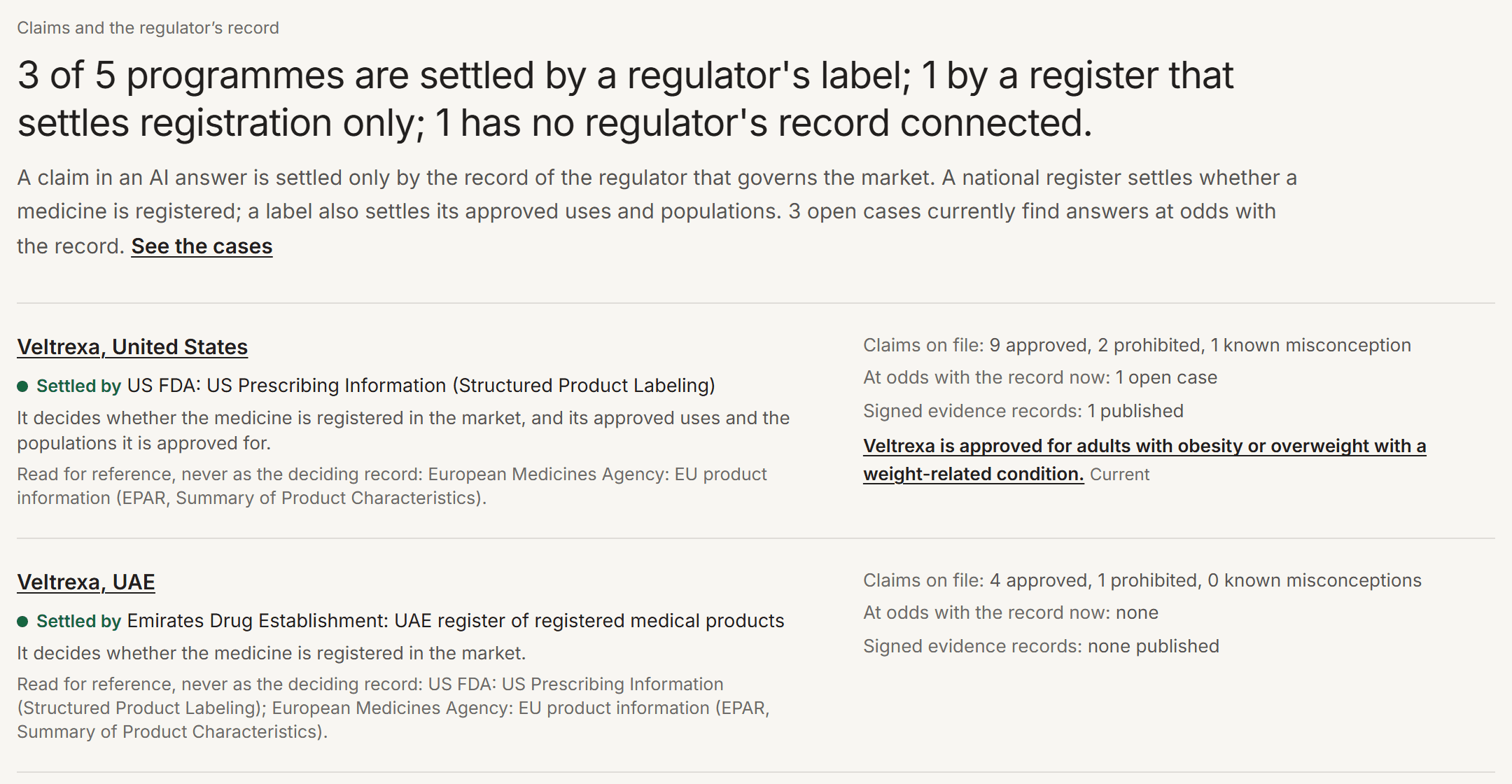
    Consequential claims are checked against the record competent to settle them, for that market, on that date. Where no record settles a claim, it is reported as unresolved, never as false.

    The Claims view: for each brand and market, which regulator's record settles its claims, and the claims at odds with it.
  3. 03 Act

    Who owns the response?

    Each discrepancy with the governing record becomes a case with an owner, a priority and that record. When a label changes under a claim you hold, UnDrift turns it into owned, approved work, ending in a correction brief for your own medical, legal and regulatory review.

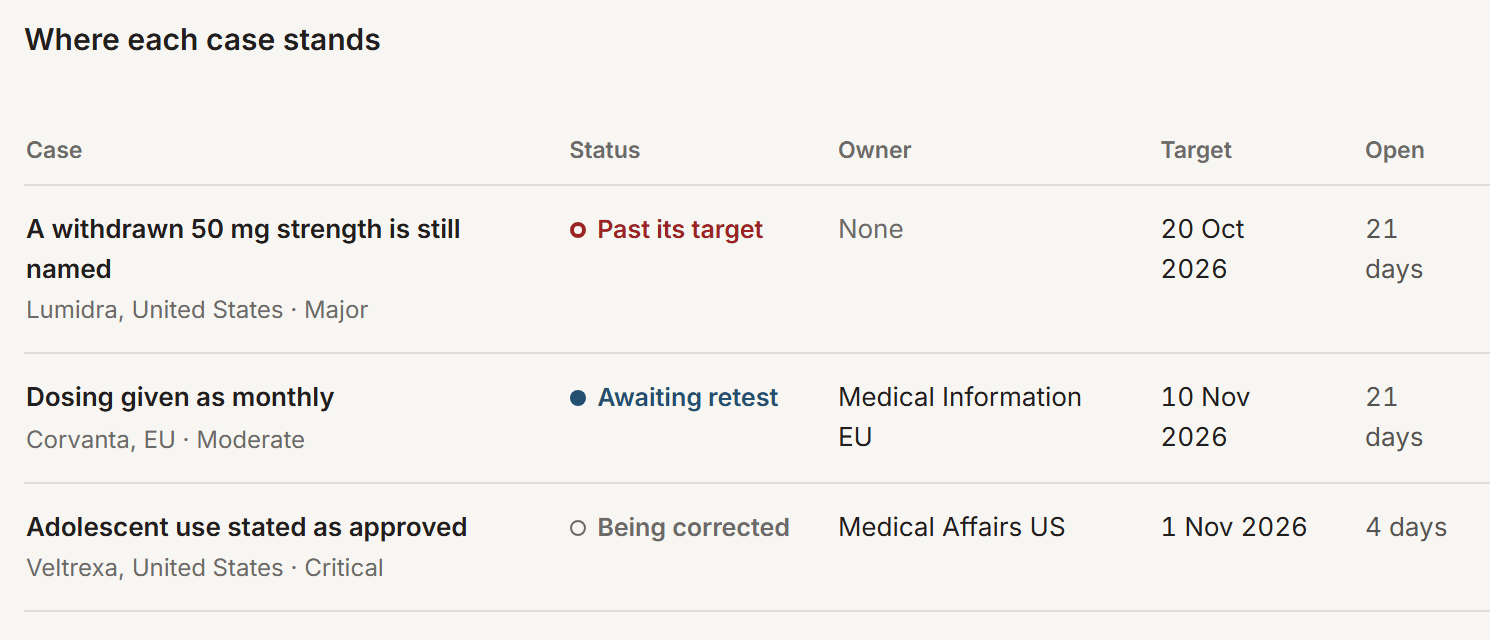
    The Cases view: where each case stands, with its status, owner, target date and days open.
  4. 04 Retest

    What changed?

    The same questions are asked again, and the record shows what the engines said next beside what they said before. A response closes only when a retest verifies it.

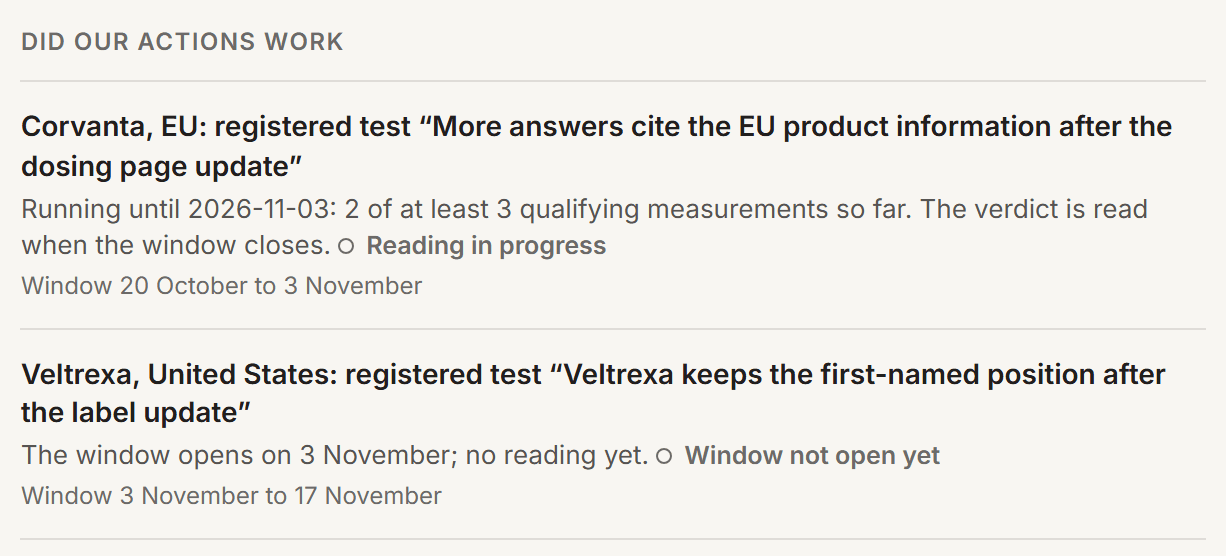
    Retests in the Brief: each registered test with what the engines said before it and since.

One traceable evidence record across the entire workflow.

Every answer, source, verdict, decision and retest sits in one record, so each step can be checked later.

Screens from the AlphaCitation account, shown with illustrative brands and data.

By function

One record. Each function asks its own question.

  • Medical Affairs

    Are AI answers about our medicines clinically accurate and current?

    Claims about approved uses and populations, checked against the current label, with every answer that diverges.

    See how a Label Ledger case works

  • Regulatory and Safety

    Is AI stating an indication, a population or a restriction our label does not support?

    Each discrepancy beside its governing record and date, on a hashed, independently timestamped record.

    Read which record settles each claim

  • Commercial and Competitive Intelligence

    How are we described beside the competitors buyers compare us with, and what moved?

    Visibility and position by engine and market, cycle on cycle, each movement with its interval.

    Read a sample brief

  • Market Access

    What do answers say about approval, coverage and access in each market?

    Those claims, read against the record that settles them where one exists, market by market.

    Try the reference lookup

  • Leadership

    Where is the portfolio exposed, and is the response working?

    The Brief: what is waiting on you, what moved, and what each retest recorded, in one view for every brand and market you hold.

    Read a sample brief

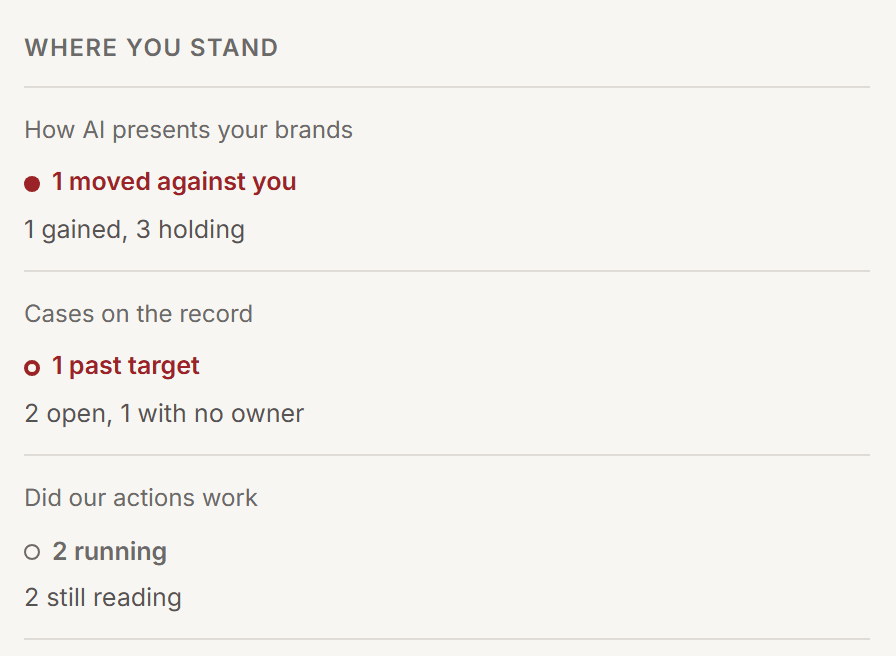
    Where you stand, in the Brief: how AI presents the portfolio's brands, the cases on the record, and whether the actions worked.
    The Brief, shown with illustrative data.

Inside your AI

Your verified record, inside your AI.

Connect AlphaCitation to Claude or ChatGPT, and your teams ask about your medicines in plain words. The assistant reads your organisation’s measured record: every rate with its numerator and sample size, every case marked with whether AlphaCitation has verified it, and only what each person’s role allows. No organisation can read another’s programmes, answers or cases, and every read is logged before any data is returned.

  • How visible is each of our medicines in each market, engine by engine?
  • Which Label Ledger cases are open?

Try it on our published sample data

Trust and procurement

Built to pass review.

  • A published standard

    The AlphaCitation Evidence-Authority Standard (EAS-Prime) sets out which evidence can settle each kind of claim about a medicine, for which market and as of which date. Version 3.0 is open under CC BY 4.0, with machine-readable rules and test vectors: the guide, doi:10.5281/zenodo.23594909.

  • Authority specific to each claim

    An approval is settled by the regulator’s own authorisation record; an approved use by its approved label. A label the authorisation holder publishes itself can support a claim, and never settles one.

  • Signed, timestamped records

    Evidence records are digitally signed, and anyone holding one can verify it at the public link it carries. Each captured answer and case event is hashed and independently timestamped (RFC 3161), so a later change can be detected.

  • Stated uncertainty

    Scores carry an interval and every rate its numerator and sample size, and a movement is confirmed only once it clears statistical noise. The method and its limits are public: Methodology.

  • Access and identity

    Team workspaces scoped by role, SCIM provisioning, single sign-on (SAML) on request, and an activity log of who viewed, verified, changed or exported what, in which every read by a connected assistant or API key is logged before any data is returned.

  • Confidentiality

    An NDA on request, before you share a single brand or market.

Every medicine. Every country. Who decides, and on what record.

The method is built for any medicine in any market: for a claim about a market, it names the authority that decides it there and that authority’s own record. We report its reach in two parts.

  • Breadth: jurisdictions and authorities

    Market by market, the regulator that authorises a medicine is named, with its own record where that record has been verified.

  • Depth: validated coverage

    Verified today against the deciding authority’s own record: approvals and approved uses and populations, against the FDA’s label in the US and the European Commission’s authorisation and product information for centrally authorised medicines in the EU and EEA. Elsewhere, the FDA and EU labels serve only as benchmarks, and a claim is settled only once the deciding authority’s own record has been read.

Detail for procurement and security review

Authoritative sources

  • Claims you register as prohibited, or as known misconceptions, are checked too, and labelled as yours, never as the regulator’s.
  • The sources behind each answer, classed by who stands behind them.

Measurement method

  • The engines are queried through their official APIs, never scraped.
  • Observed Intelligence: Google AI Mode and AI Overview answers people see in their markets, preserved with their sources, timestamped and checked against the governing evidence.
  • Alerts when something material changes.
  • The method and its stated limits are public: Methodology, including where the measurement stops.

Evidence integrity

  • For Label Ledger brands, each captured answer is stored verbatim with the time the engine returned it. Each captured answer and case event is hashed and independently timestamped (RFC 3161), so a later change can be detected.
  • Evidence records are digitally signed, and anyone holding one can verify it at a public link.

Access

  • Sign-in by a one-time link or code sent to the user’s email.
  • Organisation workspaces with owner and member roles.

The security and data-handling detail behind these is provided in full during procurement review.

The engagement

Built around your portfolio. Accountable to your teams.

  1. 01 Baseline

    Your brands, markets and competitors configured, and a first reading of what AI says about each today.

  2. 02 Findings

    The claims that matter, verified, each with its governing record and the teams it concerns.

  3. 03 Recurring intelligence

    The same questions on a set schedule, alerts when the narrative shifts, and briefings for leadership.

  4. 04 Action and retest

    Cases with owners, correction briefs through your own review, and retests that record what changed.

What you receive

  • A baseline report for each brand and market
  • The Brief, your recurring view of what moved and what is waiting on you
  • Label Ledger cases for each discrepancy with a governing label
  • UnDrift correction briefs when a label changes under a claim you hold
  • Your record in Claude or ChatGPT, and through an API key for your own systems
  • Briefings for leadership

An annual fixed fee, with an agreed scope and no usage overages.

Start with a confidential briefing.

Tell us which brands and markets matter; we’ll send a written scope, deliverables and price.

  1. We review your request.
  2. We discuss your brands, markets and priorities.
  3. You receive a written scope covering deliverables, cadence and price.

Prefer email? Write to analyst@alphacitation.com.